

Healthcare organizations depend heavily on printing – from patient records and prescriptions to consent forms and billing documents, paper is a key part of every clinical and administrative process.
Many hospitals also still rely on what we call ‘legacy print devices’ – older printers that lack modern security controls, AI automation, and efficient management tools. Printers that wouldn’t know what ‘cloud management’ was if they found it sitting in their paper tray.
While replacing an entire fleet may not be practical or affordable, AI-driven healthcare printing is emerging as a smart way to bridge the gap between outdated hardware and today’s demands for security, compliance and cost control.
All without replacing an entire printer fleet from scratch.
Securing patient data on older printers
One of the most pressing concerns with legacy hospital printers is the protection of sensitive patient information.
Older devices weren’t designed for the complex cybersecurity landscape we face today. They often come burdened with unencrypted hard drives, weak default passwords, and limited logging capabilities – all making them soft targets for data breaches .
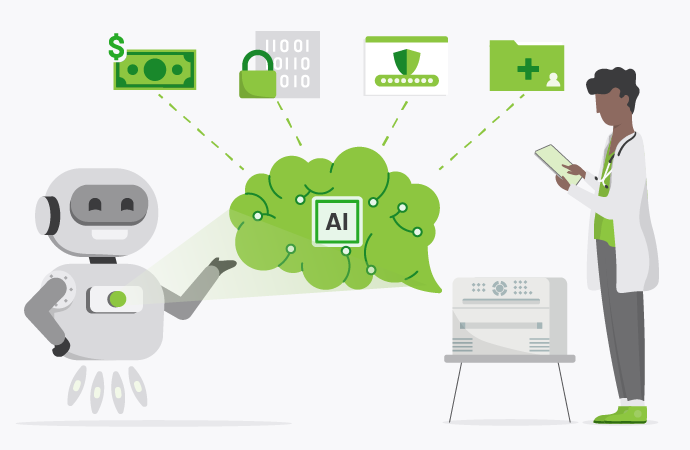
The good news is AI-powered print solutions can wrap legacy printers in layers of intelligent security.
AI can monitor print jobs in real time, detecting anomalies such as unusual print volumes, access from unauthorized users, or attempts to retrieve confidential documents without proper authentication. The kind of stuff that could easily slip through a hospital’s IT safety net.
If suspicious activity occurs, the system can automatically quarantine the job, alert IT security teams and enforce lockouts. This means you can dramatically improve your fleet’s overall security – without replacing the devices themselves. Huge money saver.
Streamlining workflows and cutting costs
The entire healthcare industry is under constant pressure to deliver better care with fewer resources. Manual print processes, like sorting output, routing documents, or tracking usage, drain staff time and inflate operational costs.
Print automation tools, powered by AI, help streamline these annoying busy tasks. AI platforms can automatically classify, and route documents based on content or department, reducing manual handling and the risk of misfiled records.
Print queues can be optimized so the most efficient device completes each job, cutting down on energy usage and consumables, and predictive analytics anticipate toner and paper needing replenishment, minimizing disruptions.
Over time, these efficiencies translate to serious savings, along with improved patient service.
Staying compliant through intelligent monitoring
Healthcare printing is subject to some of the strictest data protection and privacy requirements of any industry, and for good reason. Most regions have specific regulations governing how patient information must be handled, stored, and secured.
The challenge is that legacy printers often lack built-in compliance features, leaving hospitals exposed to security gaps, regulatory breaches, and potentially significant fines.
The solution? AI-enabled monitoring ensures that even outdated printers can operate within compliant parameters. Intelligent systems can log every print, scan, and copy event automatically, creating an audit trail for regulators.
User authentication policies can be enforced consistently, requiring staff to verify their identity before releasing sensitive documents. With AI watching over the entire legacy print fleet, hospitals can be confident that they’re meeting legal obligations, without costly upgrades.
Modernizing without replacing everything
Full replacement of a hospital’s print infrastructure can be prohibitively expensive, not to mention seriously disruptive. Without the printers running, you’d be amazed how fast an entire hospital can grind to a halt.
On the plus side, AI makes it possible to modernize legacy devices incrementally. Slowly. Piece by piece. Secure print management platforms can sit on top of existing hardware, transforming traditional printers into smart endpoints within a larger ecosystem.
Through cloud connectivity and intelligent software overlays, hospitals can actually access modern print capabilities like role-based access , automated workflows , and analytics , without ripping and replacing the hardware.
Reducing downtime and waste
Older printers (as you might expect) are more prone to jams, malfunctions and inconsistent performance. Which is a problem, because in a hospital, any delay can ultimately impact patient care.
AI helps pre-empt these problems through what’s known as ‘ proactive maintenance ’. By continuously analyzing performance data, AI algorithms can detect patterns that signal a component is wearing out, or a failure is imminent before it actually fails.
Maintenance teams receive alerts before these breakdowns occur, reducing unplanned downtime and expensive emergency repairs. At the same time, automated supply management ensures consumables are replenished precisely when needed.
No more overstocking or inconvenient, last-minute shortages.
Supporting sustainability in healthcare printing
Sustainability is gaining momentum in healthcare, as facilities look to cut waste and reduce their carbon footprint. And the fact is, legacy print devices typically consume more energy and supplies than modern machines.
It’s not a hard-and-fast rule, but generally speaking, MFDs get more efficient with each subsequent generation. But if replacing your entire fleet isn’t an option, AI-powered print solutions can help by identifying opportunities to reduce waste.
Things like defaulting to duplex printing, consolidating print jobs to minimize idle energy use, and tracking usage patterns to inform procurement decisions. Hospitals can then demonstrate measurable progress toward environmental goals, while improving efficiency at the same time.
It’s all about printing smarter, not harder .
Gaining visibility and control with AI analytics
Perhaps the most transformative benefit of AI is the level of transparency it delivers. Instead of operating blindly, hospitals and allied health clinics can finally gain granular visibility into pretty much every aspect of their print environment.
Dashboards powered by AI analytics provide real-time insights into device health, user activity, consumable usage and security events. When a potential security incident arises, AI can trigger instant alerts and recommendations for containment, ensuring rapid response and mitigation.
It’s kind of like x-ray goggles for your printer fleet.