


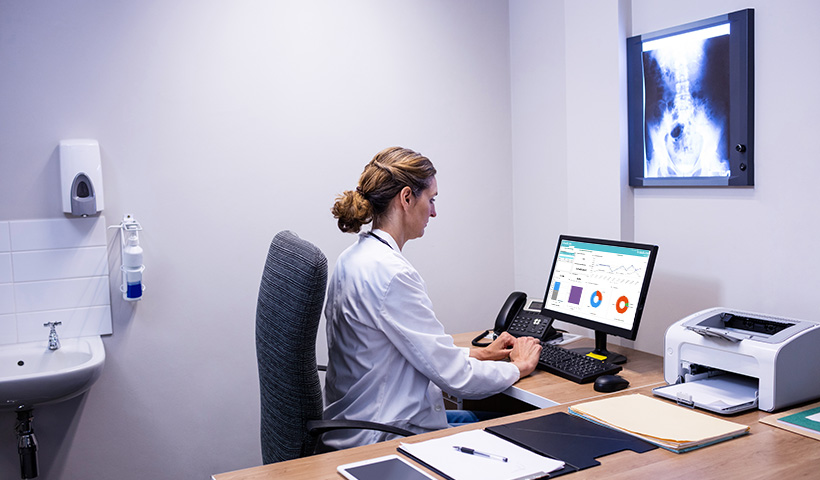
It’s well publicized that the healthcare sector is facing increasing challenges – from rising costs and staff shortages, to growing demand for services, recovery from the duress of the pandemic, and on top of it all, demands for more investment in digital health.
In 2013, the UK National Health Service published its plans to go paperless.
In 2023, The Times accessed records for NHS England (the health organization which manages the NHS), which showed that hospitals spent more than £234 million ($284 million) on the storage of paper medical records in the year to April 2022.
This equates to an enormous number of printed materials still being produced and stored, despite the aims set out.
A source from the USA in 2018 showed that on average a 1,500-bed hospital was printing 96M pages each year at a cost of $3.8M. Even if the numbers have reduced since then, progress towards a paperless healthcare system appears slow.
Print management seems a small piece of a much larger puzzle, but it can have an important part to play.
If you’ve already implemented PaperCut in your healthcare print technology with the aim of reducing waste, increasing print security, and simplifying print management, you might wonder if there’s a better way to view it all.
This blog post looks at advanced analytics for print and considers how it can add value to your healthcare organization and further leverage the investment you’ve already made in print management.
Here are two key areas to consider:
Tangible costs
The visible waste of printing is the cost of consumables, and wasted paper due to duplicate prints, and uncollected print jobs. As even the cheapest printer ink can cost twice as much per ounce as Dom Pérignon Champagne, this cost can have an impact!
Intangible costs
The intangible costs are around end user productivity - the time taken to manage printers, wait for printers to reset and for clinicians waiting for printed patient information. These intangible costs have a considerable impact on time and budgets for patient care.
Driving more value from your investment in PaperCut
The good news is that if you’ve already invested in PaperCut for print management, you should already be:
- Making cost savings through more effective printing
- Ensuring the confidentiality of patient information sent to printers
- Making printing easy so that healthcare staff & IT can focus on more important work
However, we find that many users still face challenges around data visibility. Creating regular reports from print management software can be time consuming. And it’s not always easy to drill from a high level-view down into the detail that you need to really understand what’s going on.
Using data sourced directly from PaperCut, you can begin to answer these key questions around your printing:
- Which devices are being over and underutilized across the entire organization?
- How is print demand generated across the hospital?
- How can we drive our print costs down by using more efficient devices?
- Can we get early insight into volume trends for different parts of the organization?
- How are different departments/teams using our print fleet?
- Where are the print hotspots across the entire organisation?
- How do volumes compare for colour/mono, simplex/duplex, print/scan?
- Are we achieving our environmental targets for reducing print usage?
In addition, another key benefit is in using your print data to identify paper-heavy processes that are just right for digital transformation.
Spotting those regular small print jobs that are repeated hundreds of thousands of times each week that are taking up valuable time with patients is easy if you have advanced analytics at your disposal.
This is a great place to start if you are looking for manual processes that can be automated using RPA.