


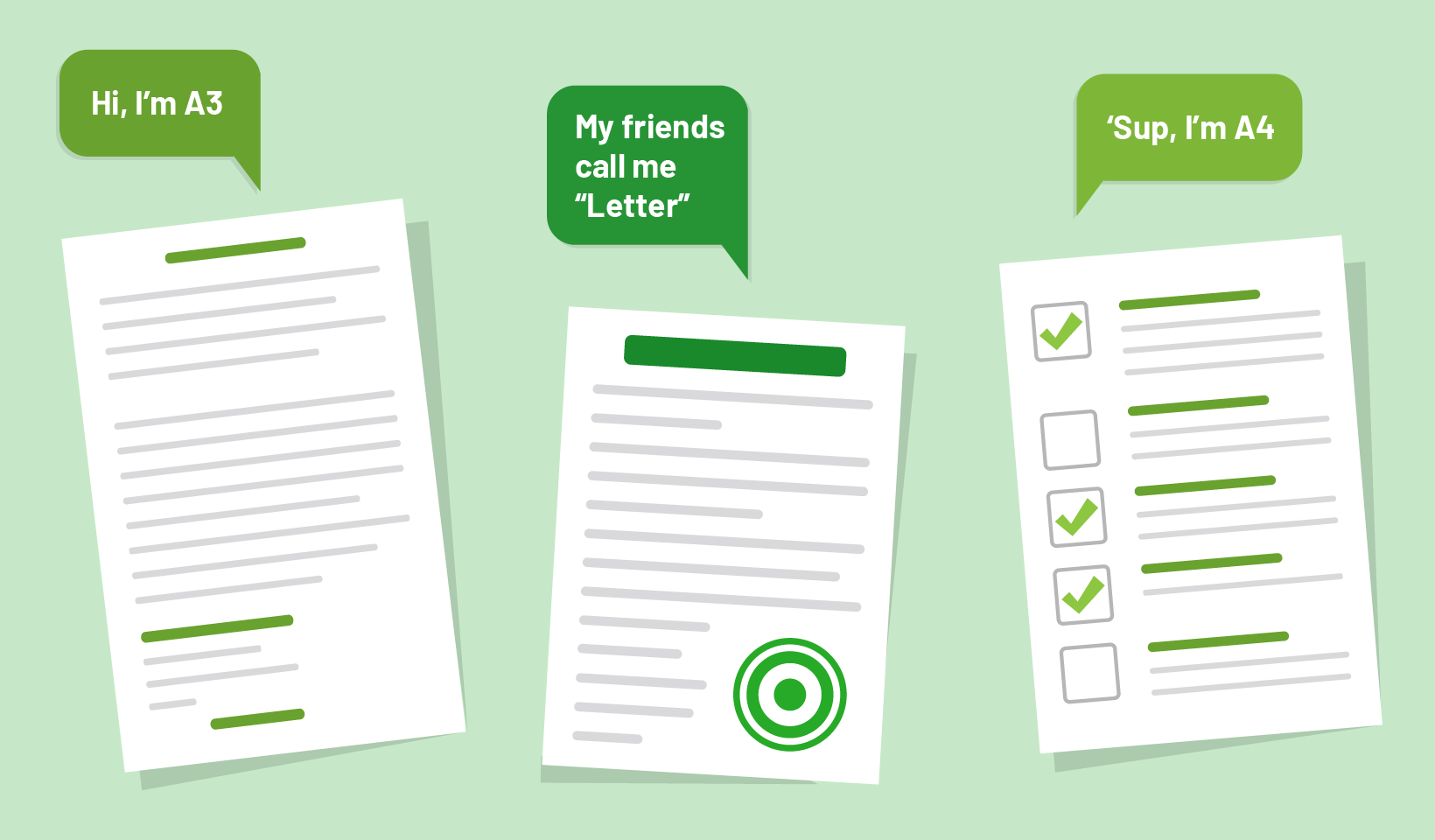
Printer paper size makes a lot of sense when you stop and think about it – without standardized sizing, printing as we know it just wouldn’t work.
Document storage would be almost impossible. Forget handouts and paper clips – there’d be mountains of odd-sized pages all over the place. In other words, printing chaos.
So how did printer paper sizes come about, and what are the standard printer paper sizes?
Let’s run through some of the common questions, and get to the bottom of printing’s biggest mystery: why do pages get bigger as the numbers get smaller?
What is the standard printer paper size?
This depends on where you live: inside America, or outside America. In the printing industry today, there are two different paper systems, known as International and North American.
The International standard, also known as ISO 216, is recognized pretty much all over the globe, except for the USA, Canada, and a few other countries which use the North American system. A little confusing, but unless you’re printing across international lines, it shouldn’t affect you too much.
North American paper sizes
North American sizes are measured in imperial units (inches), and generally come in three sizes:
Letter (8.5 x 11 inches)
This is the standard size for everyday printing and documents. It’s slightly smaller than traditional A4.
Legal (8.5 x 14 inches)
Mostly used for contracts and other legal documents. This is slightly longer than traditional A4.
Tabloid (11 x 17 inches)
Picture a small-ish newspaper (hence ‘tabloid’). This is less common than Letter and Legal paper.
International paper sizes
ISO 216 is the most common paper size standard in the world. There are a couple of sub-categories within this system, but today we’re going to stick with the most common one: A Sizes.
A Sizes range from A7 (the smallest) to A0 (the biggest). Common ones include:
A4 (210mm x 297mm)
The most common document format, used for general print-outs and note keeping. A4 is slightly narrower and a bit longer than North American Letter-sized paper.
A3 (297mm x 420mm)
Usually displayed horizontally for presentations or larger posters.
A1 (594mm x841mm)
The second biggest standard ISO paper size, often used for larger displays and signage.
What’s with the weird A numbers?
You might notice that A Size numbers get smaller as the paper itself gets bigger. This is because the A Size system is relative: each size down represents exactly half the preceding paper size, as measured across the larger dimension.
For example, an A3 sheet is exactly two A4 sheets. This gives the ISO system a better internal logic than the (slightly arbitrary) North American system, and makes quick size comparisons much easier.
How did we get standard printer paper sizes?
This depends on the system. The ISO 216 standard was established in 1975, but its origins date all the way back to German scientist Georg Christoph Lichtenberg in 1786. He was the first one who thought it might be a good idea to base paper sizes on an aspect ratio of 1:√2.
In 1921, the German-born DIN paper-format concept was adopted, and A4 was officially recommended as the standard paper size for business. In 1975, ISO 216 became the official United Nations document format.
Just two years later, approximately 88 countries had already started using the A System.
In America, the standard letter size (8.5 x 11 inches) has been around for hundreds of years, long before modern printers existed. According to the American Forest and Paper Association, it’s a result of industrial printing processes.
The old paper molds used to measure 44 x 17 inches, so the most efficient way to divide these was four lots of 8.5 x 11. In 1995, the American National Standards Institute (ANSI) made things official, and Letter, Legal and Tabloid became the de-facto paper sizes in North America.
Printing across paper size systems
ISO and North American sizes are similar, but not the same. This can cause a bit of trouble when your file dimensions and paper sizes aren’t aligned.
Most of the time, this isn’t an issue as most organizations stick to one format for their documents and paper – but if you’re printing across countries, sizing can be tricky.
There are a couple of workarounds to this problem:
Use the zoom
If your digital document is in A4, but you need to print in Letter, set the magnification to 94% of the original size. This is because A4 documents are about 6% taller than standard Letter size.
On the other hand, if you’re printing from Letter to A4, tell the recipient to print at about 97% magnification. That should give you a pretty good fit.
Adjust the paper size
Most word processors let you adjust the paper size within the digital document. You can do this when creating the document, or right before printing. It’s up to you.
For Microsoft Word, simply go to File -> Page Setup and adjust the ‘Paper Size’ to US Legal, or whatever size you’re looking for. Now you’re ready to print in North America.
Want to know more about making printing simple?

Subscribe to our newsletter
We'll keep you in the loop with the most up-to-date news, tips, and more, all in a handy dandy monthly newsletter.
This site is protected by reCAPTCHA and the Google Privacy Policy and Terms of Service apply.

