


This article first appeared in Document Manager magazine
For years, the digital transformation narrative touted the paperless office as the way forward, a utopian future where documents are a thing of the past. But in the majority of organisations, the reality is far more complex. The printer, viewed sometimes as a mundane output device, is still a vital link between our digital and physical lives. Whether signing contracts and looking over architectural designs or handing over physical documents to clients, the printer is still vital.
But when print management exists in isolation from your entire Enterprise Content Management (ECM) strategy, it creates tremendous inefficiencies and security risks. This isolation can nullify the very purpose of your digital transformation initiative.
The time is ripe to rethink the position of the printer and see it no longer as an endpoint device, but as a vital part of end-to-end content lifecycle management. By incorporating print management as part of your ECM strategy in a wise and strategic way, you can achieve new heights in security, efficiency, and visibility in your data.
The (unintended) consequences of a disconnected strategy
In numerous organisations, the ECM system carefully keeps tabs on the production, storage, and dissemination of digital documents and insists upon tight access controls and audit trails. But when the user clicks the “Print” key, the secure digital workflow commonly falls apart.
Take the following typical situations in a disconnected world:
Security gaps
A confidential HR document or a sensitive financial report is printed and left to sit in the output tray where anyone passing by can access it. This is a big risk of data breach in your organization that would be unconscionable in the digital world of your ECM.
Workflow inefficiencies
The staff member scans the signed contract onto a multifunction device (MFD), sends it in an email to their own inbox, downloads it, and then uploads it manually to the proper directory within the ECM system. This laborious process is inefficient, open to human error, and wastes time.
Lack of visibility
Not integrating printing means you lack any visibility over what is printed, who is printing it, and why. This so-called “dark data” renders the entire lifecycle of a document fully opaque to monitoring and tracking, constraining both efforts at complying and cost controls.
The power of integration: creating a unified content ecosystem
By including printing as part of your ECM strategy, you can close security loopholes and simplify processes. New-generation print management solutions are built to serve as this vital bridge between your printing and ECM worlds. The advantages of this converged strategy are profound and immediate.
1. Improved security and compliance
Integrated print management takes your ECM security controls to the document itself. Secure print release through user authentication at the printer using a PIN number, swipe card, or a mobile app means high-level documents are never left exposed while they are printed out.
In addition, through the digital audit trail created across all printing, copying and scanning activities, organisations can meet demanding regulatory needs and understand the entire lifecycle of a document.
2. Streamlined on-ramps to your digital workflows
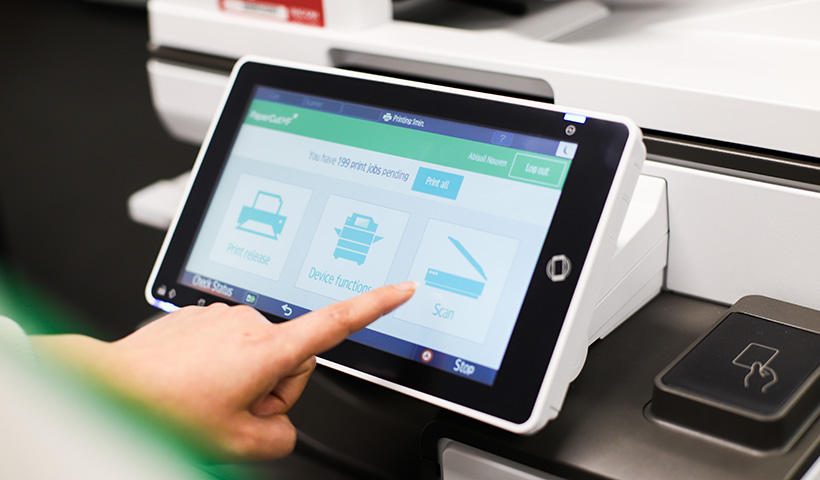
Rather than a manual multi-step process, embedded scan actions across your MFDs can serve as smart “on-ramps” to your digital processes. A user can approach a device and authenticate and, with a quick touch, send a document directly to a target location in your ECM system and automatically have the metadata attached and invoke the next business process automatically.
This doesn’t just save time but assures consistency and accuracy in capturing and storing documents.
3. Enhanced visibility and cost control
By combining your ECM with print management, you can uncover insights about your organization’s printing behavior. This same information can be used to spot areas where waste is occurring, put in place cost-savings measures such as duplex printing or grayscale printing defaults, and properly assign the printing costs to departments or projects.
This degree of visibility turns the printer from being an uncontrolled expense to a managed and optimized business device.
Making the convergence a reality
You need not make your integration process a Herculean task. Begin by posing the following key questions:
- Where are our workflow disconnects? Which manual processes bridge your digital and physical document handling?
- What are our greatest concerns in terms of printed documents? Identify the areas where you have the minimum visibility and control?
- Does our current print management solution integrate with our ECM platform? If not, then it might be time to consider new solutions created to work with today’s connected workplace.
The future of content management does not focus on physical versus digital; rather, it is about having a smooth and secure platform where the two can coexist. By incorporating intelligent print management as part of your ECM strategy, you can at last fill the gap, protecting your data, enabling your workers and creating a unified strategy for the entire document life cycle.